Casino Ba Vì and the Meaning of a Leisure Landmark
Casino Ba Vì offers a way to consider how a named place can carry leisure and cultural meaning without assuming its history, architecture, or public use.
On a map, “Casino Ba Vì” can look like a clear destination. The name alone, though, does not tell you what the place was, how its buildings were used, or what visitors did there. Casino Ba Vì is best approached as a place-based cultural subject: start with what can be documented, then separate it from interpretation.
Begin with what the name can and cannot tell you
A place-name is a useful search lead, not proof of a venue’s history. “Casino” has carried different meanings across languages and periods, from a gaming establishment to a social or leisure venue. “Ba Vì” locates the subject geographically, but it does not establish the site’s exact boundaries, original purpose, or present condition.
For Casino Ba Vì, keep the first description narrow. Record the name as it appears in the source you are using, identify who published or maintains that source, and note its date. If a source calls the site a casino, that supports reporting the label; it does not by itself confirm what activities took place there.
Do not spend time trying to decode the name as if it were a complete historical record. The useful work is to find an attributable description, a map or plan, and—where available—records that explain the site’s use.
Read the setting as context, not as a claim
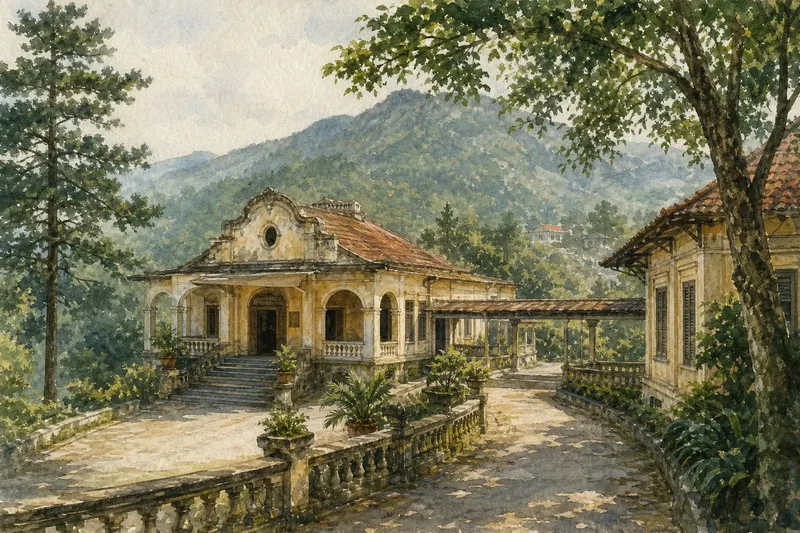
Ba Vì’s landscape is part of how the site may be encountered and described. A wooded slope, a road, or nearby buildings can help locate a place, but scenery cannot establish whether a venue served local residents, travelers, or a particular social group. Those claims need evidence beyond the view.
For a place-based account, distinguish three things: the physical setting, the activities documented at the site, and the meaning later writers attach to it. A description of location belongs in the first category. A dated notice naming an event or service may support the second. An interpretation of the site as a symbol of leisure or local identity belongs in the third and should be presented as interpretation.
This distinction matters especially when records are sparse. A quiet or abandoned building can invite stories, but appearance cannot fill gaps in the record.
Look for architectural clues without inventing a floor plan
Architecture can help explain how a venue was arranged, but only when the available material supports the claim. A photograph may show an entrance, a terrace, or a room’s proportions. A plan may indicate connections between spaces. Neither source automatically tells you how often those spaces were used or what visitors thought of them.
When examining an image or description, note visible details separately from your reading of them. For instance, “a covered walkway connects two structures” is a physical observation if the image clearly shows it. “The walkway was designed to create a grand arrival” is an interpretation that calls for plans, descriptions, or other corroboration.
Say you find an undated photograph captioned “Casino Ba Vì” and a later map that places a building near a marked road. Your actual steps are to preserve the caption and its source, compare the map’s place label and date, and note whether the image shows features that can be matched to the mapped site. The resulting account can say that the sources may refer to the same location if their details align; if they do not, keep the identification uncertain rather than turning resemblance into confirmation.
Use records to distinguish use from reputation
A venue’s reputation can outlast the details of its operation. To write about use, look for sources that name activities: a dated program, a directory entry, an official notice, a map legend, or a contemporaneous description. Treat later recollections and promotional language as evidence of how the place was remembered or presented, not automatically as a precise account of its earlier life.
Keep a simple source note for each claim:
- Observation: A source names the site “Casino Ba Vì.” If the source is identifiable and dated, then report that it used the name; if not, mark the wording as unverified.
- Observation: A map labels a building or road near the site. If the map’s date and legend are available, then use it to describe the mapped location; if not, avoid claiming an exact historical position.
- Observation: A photograph shows a particular doorway, roof, or path. If the feature is clear, then describe only what is visible; if not, do not infer the building’s function from the image.
- Observation: A notice or program names an activity. If it is connected to the site and dated, then state that the activity was advertised or recorded; if not, do not present it as established use.
- Observation: A later account calls the place a landmark. If you can identify whose description it is, then attribute the characterization; if not, leave the label out.
- Observation: Two sources give different dates or names. If both can be traced, then present the discrepancy and its sources; if not, use the narrower claim they have in common.
This approach is more useful than collecting colorful descriptions without checking where they came from. What is not worth the effort is forcing every source into one tidy narrative when the records may not support it.
Explain cultural significance as an argument
Calling a place culturally significant is not a substitute for explaining why. The case may rest on its relationship to local leisure, its architecture, the way it appears in memory, or its role in a broader account of Ba Vì. State which kind of significance you mean, then point to the evidence that supports that reading.
Be careful with claims about who visited or what the site meant to them. A building’s name and appearance do not reveal its audience. A dated source that identifies visitors or an activity can support a more specific statement; without that, describe the question as open rather than guessing.
What can a reader reasonably establish about Casino Ba Vì?
Does the name prove that Casino Ba Vì offered gambling?
No. The name is evidence of how a source labels the place, not a complete record of its activities. Look for a dated description, notice, or other source that directly identifies what took place there.
Can architecture show how visitors used the site?
Architecture can show visible arrangements, such as entrances or links between buildings, when the evidence is clear. It cannot by itself establish how visitors moved through the site or what they intended to do there.
How should conflicting accounts be handled?
Keep the accounts separate, identify their sources and dates, and state exactly where they disagree. If their shared details are limited, make only the claim those details support.
What makes a place a leisure landmark?
The label needs a reason, such as documented public recognition, a sustained role in local leisure, or an identifiable place in cultural memory. Attribute the judgment to its source or explain the evidence behind your own interpretation.
Build a careful account from the evidence
Imagine you have a dated map that marks “Casino Ba Vì,” an undated photograph of a building, and a later article that calls the site a popular gathering place. First, record the map’s title, date, and exact label. Next, describe only the architectural features visible in the photograph and say that its date is unknown. Then check whether the later article identifies its sources or names particular activities. If it does not, you can report that the article characterized the site as a gathering place, but you cannot independently establish who gathered there or when. The tradeoff is a less dramatic story in exchange for a more defensible one.
For Casino Ba Vì, the most useful account connects place, architecture, leisure, and memory while keeping each claim tied to its evidence. Start with an attributable name and location, describe features that sources actually show, and mark cultural interpretation as interpretation. That method leaves room for the site’s significance without asking a label or a photograph to tell more than it can.