How to Read a Casino Ba Vì Directory Board
A Casino Ba Vì directory board can help you find a destination and understand how the venue presents its spaces, without mistaking labels for experience.
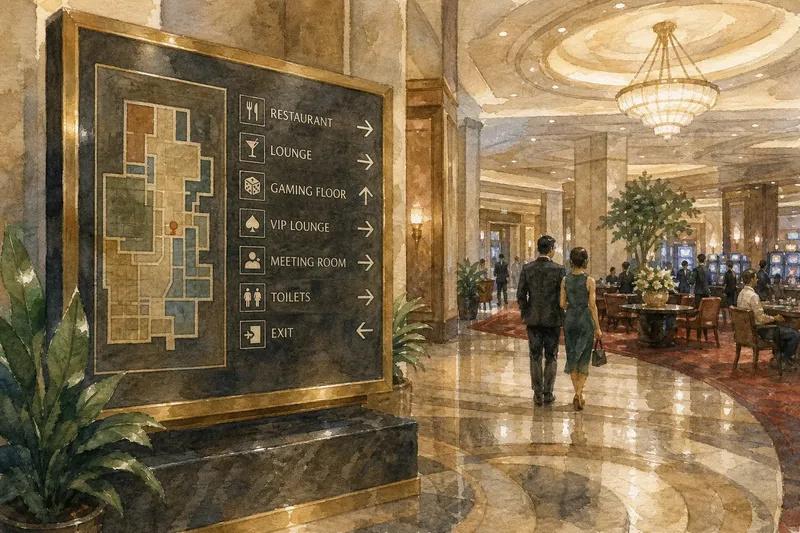
You pause beside a directory board at a casino and scan for the dining room. A Casino Ba Vì directory board can help with that immediate choice, but its labels alone cannot tell you how visitors experience the venue or how its spaces relate to one another.
Use the sign for orientation, then decide what you want to notice beyond it. A directory is a practical object: it names destinations and channels movement. Reading it closely can also show how a venue chooses to present its spaces, provided you separate what the board says from what you observe.
Start with the destination you need
Look for the room name, any floor or route information, and signs that distinguish visitor areas from restricted ones. Follow the posted directions. If a term is unclear or a route appears closed, ask staff rather than guessing.
For a simple visit, that may be all you need. If you are meeting someone at a restaurant, use the directory to get oriented; there is no need to turn a routine wayfinding task into an investigation of the building.
Notice how the board organizes the venue
A directory groups places into categories. That makes destinations easier to find, but the grouping is a choice about what visitors should notice first. Compare the sign’s wording with the spaces you can see from public areas, and note which destinations are named separately or placed under a broader category.
Keep the observation narrow. A board that lists dining and lounge areas tells you how the sign classifies them. It does not establish how often visitors move between them, what they do there, or why the venue chose those labels.
If you are writing about place or architecture, record simple relationships: whether a named room opens onto a corridor, whether a transition is clearly marked, and whether a destination is easy to locate from the entrance. These details describe the visitor’s route without assigning motives to the people who designed or use the building.
Use a short observation checklist
Before making a note, decide whether you are recording the sign, the space, or your own impression. The following checks keep those records distinct and help determine what to do next.
- Board wording: Check the exact name of the destination. If the wording is clear, transcribe it; if it is ambiguous, mark it as unclear and ask staff rather than supplying your own meaning.
- Route information: Check for a floor, arrow, or corridor direction. If the route is stated, follow it; if it is missing or conflicts with other signs, pause and ask staff.
- Access notice: Check for restricted-area wording or barriers. If access is clearly public, continue along the marked route; if it is restricted or uncertain, do not enter and request directions to a public destination.
- Visible connection: Check whether the sign’s named room is visibly connected to a corridor or another public space. If the connection is apparent, describe that physical relation; if it is not, avoid guessing and note that the route was not visible.
- Sign condition: Check whether the board appears current and legible. If it is readable and consistent with nearby signs, use it for orientation; if it looks outdated or conflicts with another notice, confirm the destination with staff.
- Photography rules: Check posted notices or ask staff before taking a photograph. If photography is allowed, a picture can preserve the wording; if it is not allowed or remains uncertain, write a brief note instead.
Keep venue interpretation grounded in what you can see
A directory is useful for studying how a venue presents itself, not for explaining every aspect of its social life. You can describe its categories, the route they imply, and the way public spaces meet. Avoid turning one passing observation into a claim about typical visitor behavior.
Say you arrive at Casino Ba Vì with an invented, hypothetical aim: to describe how a visitor might move between dining and lounge areas. You first write down the board’s exact labels. You then follow only public directions and note whether the route between the named areas is visible or requires another sign. If the connection is clear, your resulting account can say that the directory separates the destinations while the public route links them; if it is not clear, the account should say that the sign alone does not show how to move between them. Either way, you have a specific observation without claiming how visitors generally behave.
What can a directory board answer?
Can a directory tell me where a room is?
Usually, its purpose is to point visitors toward named destinations, though a particular board may not include every route detail. If the directions are incomplete, check with staff before proceeding.
Does a room label describe everything that happens there?
No. It records the venue’s chosen name or category, not every activity or visitor’s experience. Describe the label as a label and keep any personal observation separate.
Can the board explain the venue’s history?
Not on its own. A directory may tell you how spaces are presented at the time you encounter it, but it cannot establish when a name or arrangement began.
Should I photograph the board?
Only if photography is permitted. If you cannot confirm that, write down the wording and where the sign stands instead.
Write down the sign and the setting separately
Use two short notes if you are documenting a visit. In the first, record the board’s wording and where you saw it. In the second, describe visible features such as a marked route, a doorway, or the relation between a public corridor and a named room.
Mark impressions as impressions. “The corridor felt quiet during my visit” is a bounded observation; “the corridor is always quiet” reaches beyond what a single visit can support. If your purpose is cultural interpretation, that distinction keeps your account focused on the venue as encountered rather than on assumptions about its visitors.
What is not worth the effort is treating every label as a hidden message. Read the sign plainly, follow permitted routes, and describe only the connections you can observe. A Casino Ba Vì directory board is most useful as a record of named destinations and the venue’s public presentation; your own notes can add the detail of how those destinations meet in the space.